















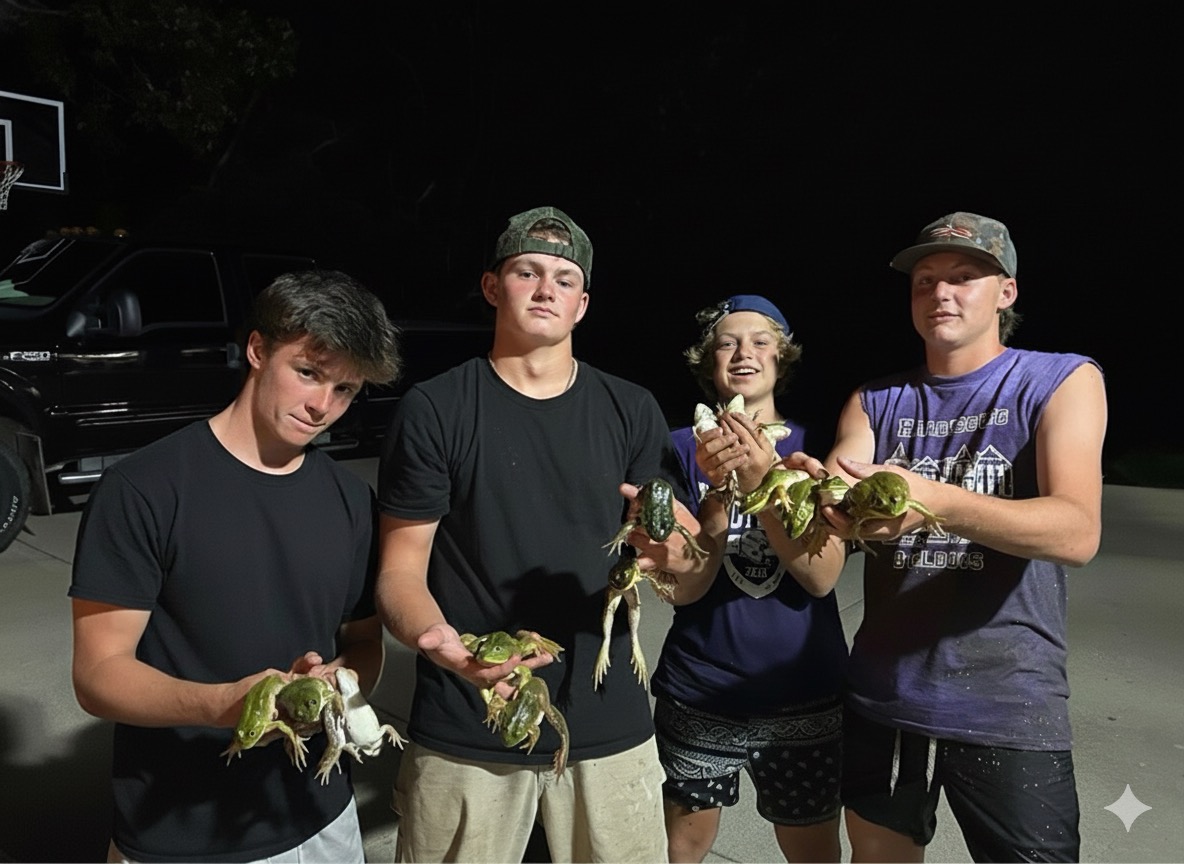
When most people think of hunting, they picture deer season, turkey calls or duck blinds at sunrise. But across small towns in southern Illinois and much of rural America, there’s another kind of hunting that takes place under the stars, frog gigging.
Frog gigging is the practice of catching frogs, usually bullfrogs, using a tool called a gig. A gig looks like a small spear with several sharp prongs on the end. At night, hunters wade quietly along the edges of ponds, creeks and lakes, shining flashlights or headlamps across the water. The frogs’ reflective eyes glow under the beam, making them easier to spot. Once located, the hunter carefully sneaks up and uses the gig to spear and catch the frog.
Unlike traditional hunting, frog gigging doesn’t require firearms or large game. It’s a slower, quieter sport that demands patience, steady hands and sharp eyesight. Many locals describe it as a favorite summer pastime that combines the thrill of the hunt with time outdoors among friends and family.
“The best part is when you finally spot one and manage to get it,” said student hunter Ian Crabb. “Frog gigging is one of my favorite memories. It’s exciting and rewarding when you actually catch one.”
Another local hunter, Burke Wilson, agreed. “It’s something fun to do in the summer when it’s warm out,” he said. “It’s not just about catching frogs — it’s about hanging out and enjoying the night.”
Once caught, bullfrogs are often cleaned and cooked, with their frog legs fried or grilled — a delicacy in many Midwestern households and small-town diners. According to the Illinois Department of Natural Resources, the state even has a regulated frog season, typically running from mid-June through October, to help ensure populations stay healthy.
Frog gigging isn’t the only unusual outdoor activity popular in southern Illinois. Another growing nighttime sport is carp bowfishing, a blend of archery and fishing that targets the state’s invasive Asian carp population. Bowfishers use a compound bow equipped with a reel and fishing line to shoot carp that swim near the surface of rivers and lakes. Many go out after dark, their boats outfitted with bright spotlights to illuminate the water. When startled, the carp are known for leaping into the air sometimes even into the boats, creating both excitement and chaos.
“It’s definitely not your average fishing trip,” said one bowfisher from the area. “You have to be fast, accurate and ready for a carp to jump right at you.”
Beyond the thrill, bowfishing also serves a practical purpose. Asian carp are an invasive species that compete with native fish for food and habitat. Removing them helps protect local ecosystems and waterways, including those in the Ohio and Mississippi River systems that run along the southern tip of Illinois.
For some southern Illinois anglers, fishing means getting even closer to the catch — literally. Catfish noodling, also known as hand fishing, is a daring method that involves catching catfish using nothing but your hands. Noodlers wade into shallow waters of rivers and lakes, such as Rend Lake, the Saline River or parts of the Wabash, and search for catfish hiding in underwater holes or crevices. When a hand finds a fish’s mouth, the noodler grabs it and pulls it to the surface. The catfish, which can weigh anywhere from 20 to 50 pounds, often puts up a strong fight.
Noodling is legal in Illinois, though regulations limit which species and sizes can be taken. The sport has grown in popularity in recent years, often passed down through generations as a local tradition of courage and skill.
While it may sound risky, enthusiasts describe noodling as the ultimate test of strength, patience and bravery and as with frog gigging or bowfishing, it’s as much about the experience and the company as it is about the catch.
Whether it’s shining a flashlight across a quiet pond, scanning a river for carp under the moonlight or wrestling a catfish by hand, these unique traditions highlight the adventurous spirit of southern Illinois.